
Rocket Motor Classifications: What Does K550W-14A Mean?
Rocketry, Explained — Part 1
At a high-power launch, you might hear motors called K550W, L930, or N1100. Their labels describe different parts of the flight: the total impulse range, the nominal average thrust, and sometimes the propellant and recovery delay.
Take the AeroTech K550W-14A: K is the impulse class, 550 is nominal average thrust in newtons, W identifies White Lightning propellant, and 14A denotes a nominal 14-second adjustable recovery delay. AeroTech’s product page identifies this reload and its delay-adjustment tool.
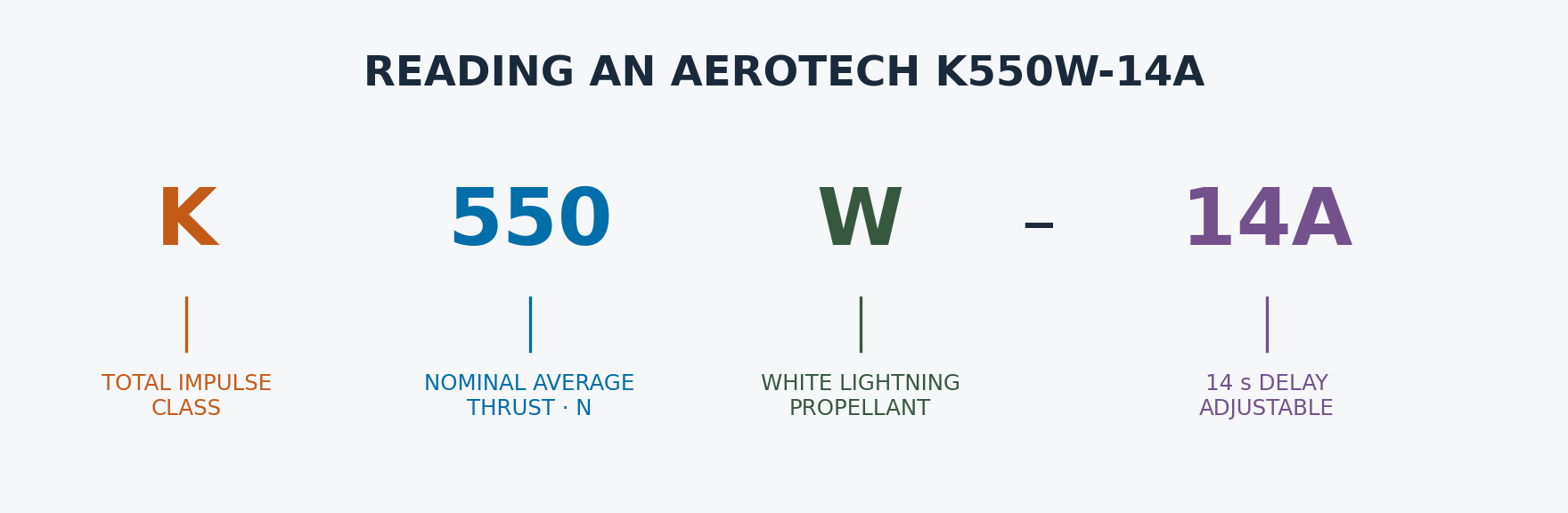
The letter: how much push, added up over time?
The letter identifies a total impulse range. A K motor delivers more than 1,280 N·s, up to and including 2,560 N·s. Impulse combines force with duration; its unit is the newton-second, written N·s. It is not energy, and it is not a predicted altitude.
For a constant push, multiply thrust by time. For a real motor’s changing thrust, add up the area under its thrust curve. NASA explains total impulse here.
The class ceiling doubles at each step.
The table runs from the smallest class in the source note through its extended AJ comparison. Class boundaries below are calculated by exact doubling, avoiding rounding drift in the original table.
Reading the examples: The reference column preserves the examples from the Obsidian note. The large-rocket examples are comparisons from that note and have not been independently verified. They mix individual motors, stages, complete vehicles, and proposed designs. Beyond O, treat the letters here as an extension of the doubling scale, rather than an industry naming system. A vehicle’s configuration and which engines or stages are counted matter.
| Class | Total impulse | Reference notes / examples |
|---|---|---|
| ⅛A (Micro) | 0 → 0.3125 N·s 0.00 → 0.07 lbf·s |
micro rockets |
| 1/4A | 0.3125 → 0.625 N·s 0.07 → 0.14 lbf·s |
Estes model Rockets |
| 1/2A | 0.625 → 1.25 N·s 0.14 → 0.28 lbf·s |
Estes model Rockets |
| A | 1.25 → 2.5 N·s 0.28 → 0.56 lbf·s |
Estes model Rockets |
| B | 2.5 → 5 N·s 0.56 → 1.12 lbf·s |
Estes model Rockets |
| C | 5 → 10 N·s 1.12 → 2.25 lbf·s |
Estes model Rockets |
| D | 10 → 20 N·s 2.25 → 4.50 lbf·s |
Estes model Rockets |
| E | 20 → 40 N·s 4.50 → 8.99 lbf·s |
Mid-Power Rockets |
| F | 40 → 80 N·s 8.99 → 17.98 lbf·s |
Mid-Power Rockets |
| G | 80 → 160 N·s 17.98 → 35.97 lbf·s |
Mid-Power Rockets |
| H | 160 → 320 N·s 36 → 72 lbf·s |
Level 1 High Power Rockets |
| I | 320 → 640 N·s 72 → 144 lbf·s |
Level 1 High Power Rockets |
| J | 640 → 1,280 N·s 144 → 288 lbf·s |
Level 2 High Power Rockets |
| K | 1,280 → 2,560 N·s 288 → 576 lbf·s |
Level 2 High Power Rockets |
| L | 2,560 → 5,120 N·s 576 → 1,151 lbf·s |
Level 2 High Power Rockets |
| M | 5,120 → 10,240 N·s 1,151 → 2,302 lbf·s |
Level 3 High Power Rockets |
| N | 10,240 → 20,480 N·s 2,302 → 4,604 lbf·s |
Level 3 High Power Rockets |
| O | 20,480 → 40,960 N·s 4,604 → 9,208 lbf·s |
Level 3 High Power Rockets |
| P | 40,960 → 81,920 N·s 9,208 → 18,416 lbf·s |
|
| Q | 81,920 → 163,840 N·s 18,416 → 36,833 lbf·s |
|
| R | 163,840 → 327,680 N·s 36,833 → 73,665 lbf·s |
USCRPL’s Traveler IV |
| S | 327,680 → 655,360 N·s 73,665 → 147,331 lbf·s |
WAC Corporal; CSXT GoFast; DARE’s Stratos III |
| T | 655,360 → 1,310,720 N·s 147,331 → 294,662 lbf·s |
|
| U | 1,310,720 → 2,621,440 N·s 294,662 → 589,323 lbf·s |
Apollo launch escape rocket |
| V | 2,621,440 → 5,242,880 N·s 589,323 → 1,178,646 lbf·s |
Bloodhound SSC hybrid rocket |
| W | 5,242,880 → 10,485,760 N·s 1,178,646 → 2,357,293 lbf·s |
SS-520 |
| X | 10,485,760 → 20,971,520 N·s 2,357,293 → 4,714,585 lbf·s |
Lambda 4S |
| Y | 20,971,520 → 41,943,040 N·s 4,714,585 → 9,429,170 lbf·s |
Vanguard; GEM-40 SRB; Electron |
| Z | 41,943,040 → 83,886,080 N·s 9,429,170 → 18,858,341 lbf·s |
Black Arrow; Mercury-Redstone; Pegasus-XL |
| AA | 83,886,080 → 167,772,160 N·s 18,858,341 → 37,716,682 lbf·s |
Falcon 1; Minotaur I; VLS-1 |
| AB | 167,772,160 → 335,544,320 N·s 37,716,682 → 75,433,364 lbf·s |
M-V; Minotaur-C; Strela |
| AC | 335,544,320 → 671,088,640 N·s 75,433,364 → 150,866,728 lbf·s |
Ariane 3; Titan II; Dnepr |
| AD | 671,088,640 → 1,342,177,280 N·s 150,866,728 → 301,733,456 lbf·s |
Vostok; Delta II; Falcon 9 v1.0 |
| AE | 1,342,177,280 → 2,684,354,560 N·s 301,733,456 → 603,466,912 lbf·s |
Falcon 9 v1.1; Falcon 9 Full Thrust; Delta IV Heavy |
| AF | 2,684,354,560 → 5,368,709,120 N·s 603,466,912 → 1,206,933,823 lbf·s |
Atlas V Heavy; Falcon Heavy; New Glenn |
| AG | 5,368,709,120 → 10,737,418,240 N·s 1,206,933,823 → 2,413,867,646 lbf·s |
Space Shuttle; Saturn V; Space Launch System |
| AH | 10,737,418,240 → 21,474,836,480 N·s 2,413,867,646 → 4,827,735,292 lbf·s |
Ares V; Long March 9; Starship |
| AI | 21,474,836,480 → 42,949,672,960 N·s 4,827,735,292 → 9,655,470,585 lbf·s |
Interplanetary Transport System |
| AJ | 42,949,672,960 → 85,899,345,920 N·s 9,655,470,585 → 19,310,941,169 lbf·s |
Sea Dragon; UR-700M |
Both impulse ranges use the same interval: above the lower bound, through and including the upper bound (the first row begins at zero). Values in lbf·s are rounded to the nearest hundredth below H and to the nearest whole number for H and above; classification follows the N·s boundaries. 1 lbf·s = 4.4482216152605 N·s.
Examples illustrate the scale; actual vehicle performance depends on its configuration.
High-power certification: which motors can you fly?
In the U.S., high-power flyers qualify through certification programs such as Tripoli Rocketry Association’s. The table’s level labels indicate the usual motor-class progression. Tripoli’s getting-started guide outlines the levels.
- Level 1: H and I motors.
- Level 2: adds J, K, and L motors.
- Level 3: covers M motors and larger under Tripoli’s program, subject to applicable flight approvals.
Check the specific motor, not just its letter. Certain F and G motors also require high-power certification—for example, motors exceeding 80 N average thrust, hybrids, and spark-producing motors. Propellant quantity and the complete rocket’s loaded mass can also bring a flight into high-power requirements. The “Mid-Power” label is therefore only a broad guide. Tripoli’s Unified Safety Code defines these exceptions.
Flyer certification and motor certification are different: one qualifies the person; the other identifies a tested motor configuration. Check the exact motor’s current approval and applicable launch requirements. Tripoli Motor Testing links to the Combined Certified Motor List.
The first number: how hard does it push?
The 550 in K550W-14A means a nominal average thrust of 550 newtons. It does not mean a constant 550 N throughout the burn. Measured average thrust can differ from the printed designation.
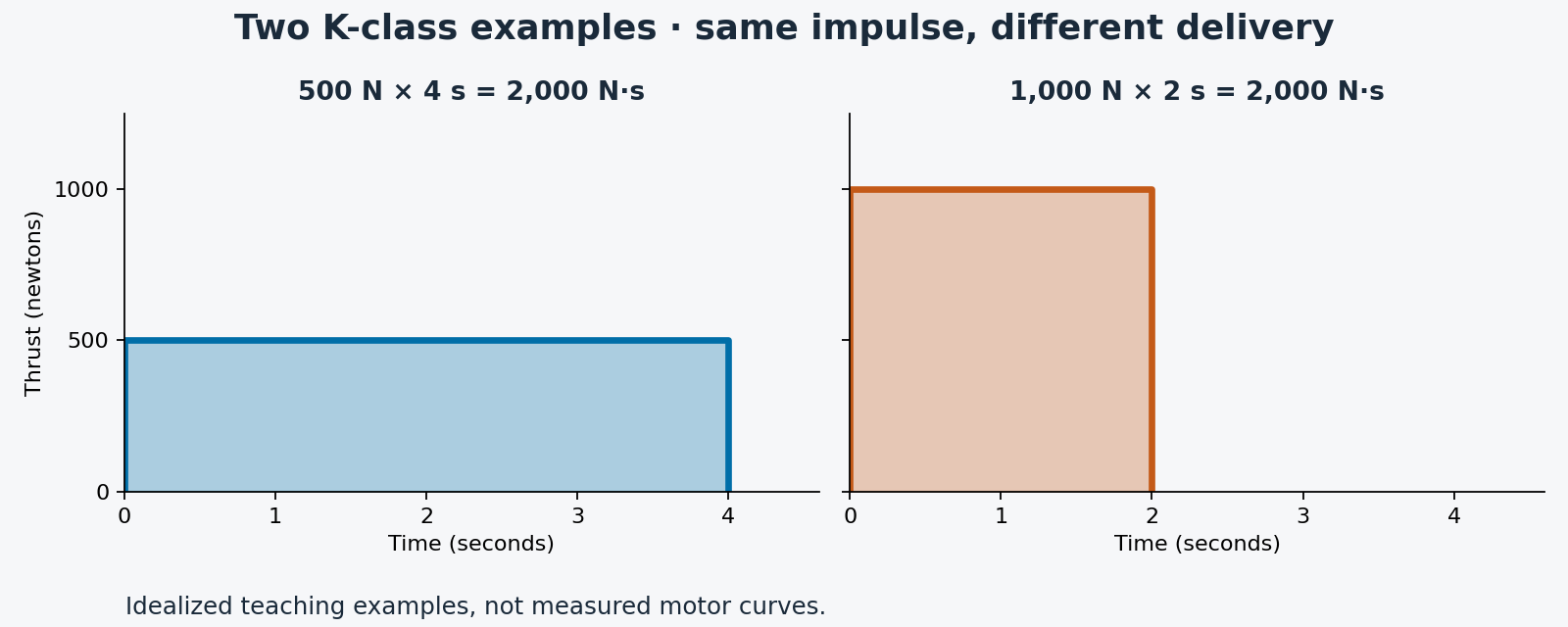
Both teaching examples deliver 2,000 N·s, placing them in the K class. One pushes twice as hard for half as long. They illustrate impulse and average thrust; they are not specifications for the K550 or another particular motor.
Propellant suffixes add information too: AeroTech’s W denotes White Lightning; Loki’s LW, LR, and LB identify Loki White, Red, and Blue. These are manufacturer-specific names. Compare the complete curve and motor configuration rather than assuming a suffix fixes the burn duration.
For actual motor comparisons, use certified test data. A letter alone cannot tell you the burn time or initial thrust. Tripoli Motor Testing provides motor certification and performance resources.
The delay suffix: when does recovery happen?
On K550W-14A, 14 identifies the nominal motor-ejection delay in seconds after burnout, while A indicates an adjustable delay. The 14 seconds is not the powered burn time. The motor’s specified drilling tool can shorten that delay to match the intended recovery timing.
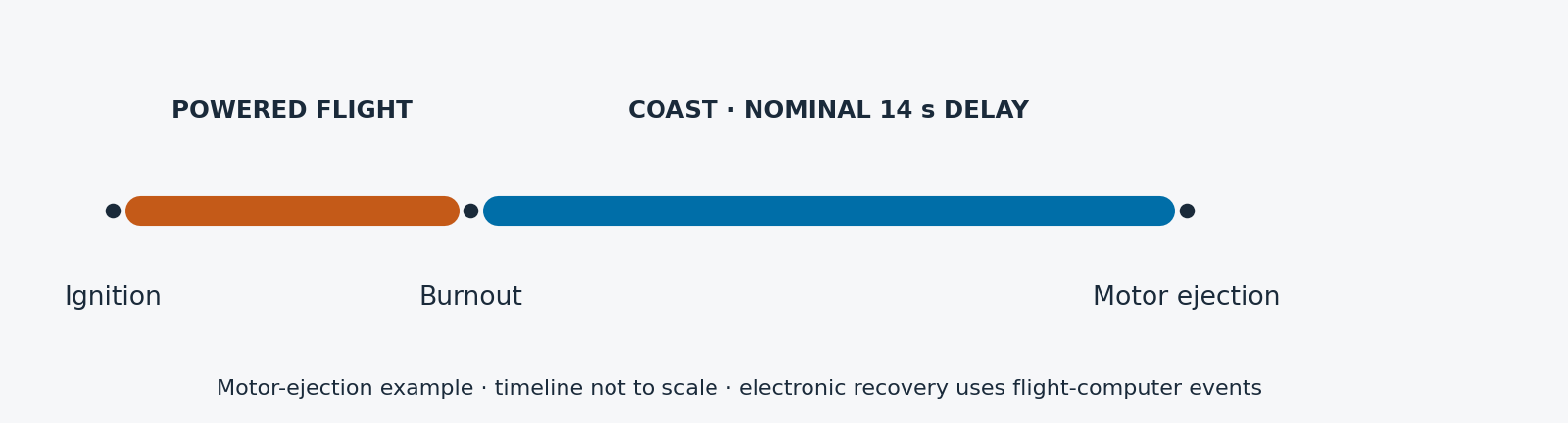
Not every high-power motor has a numeric recovery delay. A designation or specification marked P or plugged indicates no motor-ejection recovery; the rocket needs an independent deployment system. The Loki L motors in Part 2 use independent recovery rather than a selectable motor-ejection delay.
High-power rockets: electronics take over
Many high-power rockets—especially larger, more complex vehicles—use electronic deployment instead of relying on a motor’s recovery delay. A flight computer detects flight conditions and commands an electrically initiated ejection or release mechanism. In a typical dual-deployment flight, it commands drogue deployment near apogee and main deployment at a selected altitude during descent. Our SPARK-S4 uses Raven flight computers with CO₂ deployment and a separate main-release mechanism. See Featherweight’s Raven documentation.
A plugged motor provides no motor-ejection deployment; the rocket needs an independent recovery system. Some motors still include a delay element for smoke even when it is not used to trigger recovery. A motor delay can also serve as a backup in a suitably designed system. The important distinction is what commands recovery, not simply whether a delay element is present. AeroTech identifies plugged motors as requiring electronic recovery deployment.
Adjustable delays and delay drilling tools
High-power motors that support motor ejection may have an adjustable delay grain. A manufacturer-approved delay drilling tool removes a controlled amount of delay material, shortening the time before ejection. It changes the recovery delay—not the motor’s thrust duration or impulse class.
For example, shortening a nominal 14-second delay by 4 seconds gives a nominal 10-second delay. The tool’s setting may indicate seconds removed, rather than the final delay. AeroTech’s 54mm RMS tool is one example. Use the tool and current instructions specified for the exact motor: tool compatibility, permitted reductions, minimum remaining delay, and assembly requirements vary. Drilling can shorten a supported delay; it cannot lengthen one. AeroTech’s 54mm RMS delay-tool guidance.
What the label leaves out
A motor code is a useful introduction, not a complete flight plan. It leaves out the rocket’s mass, drag, stability, motor fit, and recovery configuration. Compare suitable motors using the rocket manufacturer’s guidance, measured thrust curves, and a flight simulation.
Try it: Shorten the K550W-14A’s nominal delay from 14 seconds to 10 seconds using the specified adjustment procedure. What changes? Motor-ejection timing. The impulse class, propellant, and thrust curve stay the same.
Next: Reading a Thrust Curve: Fast, Medium, and Slow Loki Motors.