
Reading a Thrust Curve: Fast, Medium, and Slow Loki Motors
Rocketry, Explained — Part 2
An L motor can deliver a short, hard push or a much longer burn. The letter describes an impulse range; the thrust curve shows how that impulse arrives.
To see the difference, compare three Loki reloads that use the same 76/3600 hardware: L480 Red, L930 White, and L1482 Blue. These are actual high-power motors with different propellants and different thrust histories.
Same hardware, three different burns
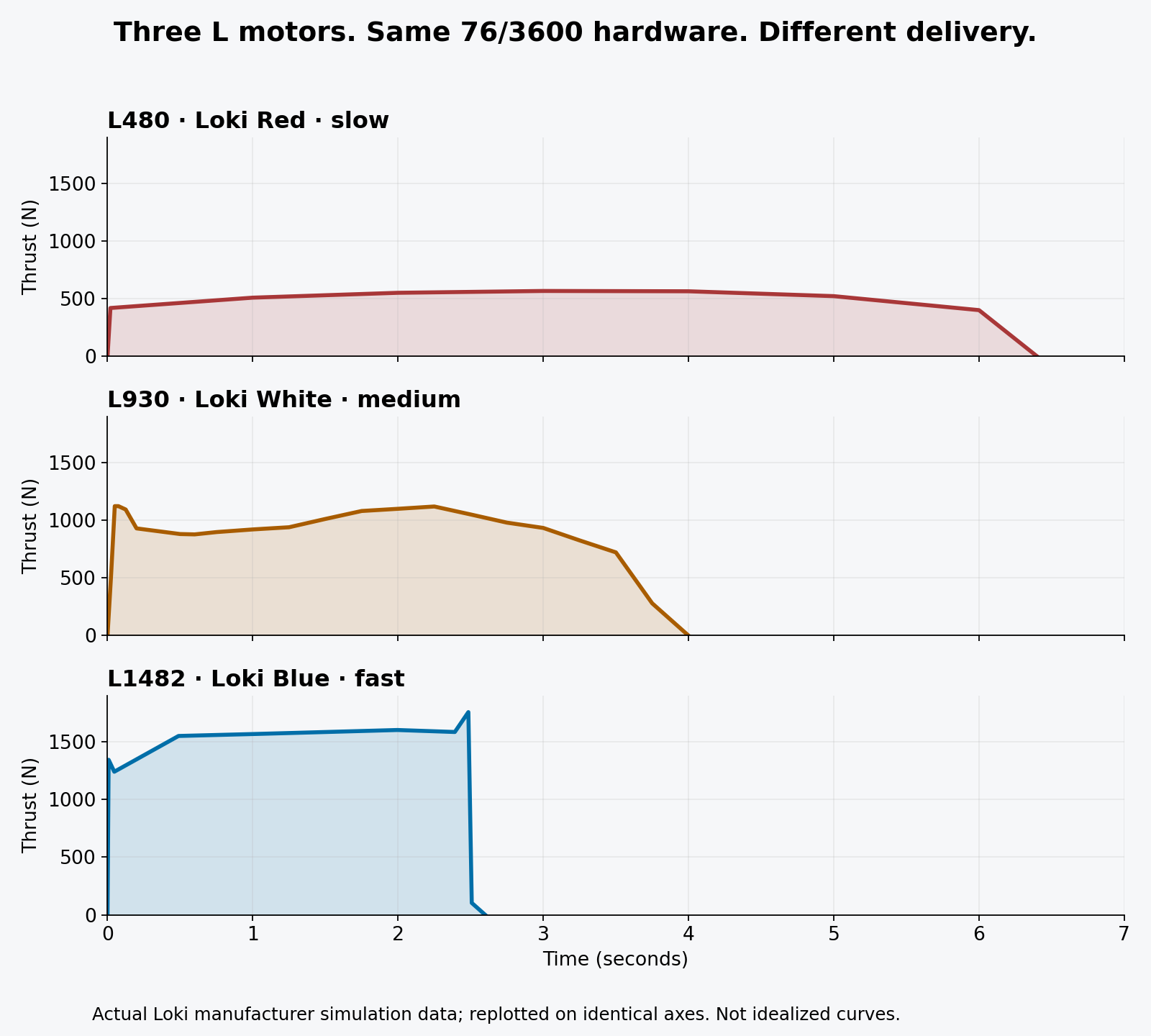
Curves replotted from Loki’s published motor simulation file, linked from its documents page. Lines connect the supplied data points; no hypothetical curve shapes are used. All three panels share the same scales.
| Motor | Propellant | Relative burn | Catalog burn time | Catalog total impulse |
|---|---|---|---|---|
| L480-LR | Loki Red | Slow | 6.4 s | 3,200 N·s |
| L930-LW | Loki White | Medium | 3.8 s | 3,587 N·s |
| L1482-LB | Loki Blue | Fast | 2.6 s | 3,882 N·s |
Specifications: Loki’s reload catalog. “Slow,” “medium,” and “fast” describe these three motor configurations relative to one another. They are not universal ratings for every motor using those propellants.
The motors share a case family and impulse class, but their total impulses are not equal. This is a practical hardware comparison, not a controlled experiment isolating propellant chemistry. Grain geometry, nozzle configuration, and propellant loading also affect the result.
Red: a longer, gentler push
The L480 starts around 420 N in the first recorded nonzero sample, builds toward roughly 570 N, and spreads its push across more than six seconds. It suits the discussion of a sustained burn: lower thrust delivered for longer. Whether it suits a particular rocket still depends on loaded mass and departure speed.
White: a stronger opening and a middle-length burn
The L930 rises quickly above 1,000 N, drops somewhat, then builds through a broad middle section. It delivers substantially more early thrust than the Red example, without compressing the burn as much as the Blue.
Blue: the hardest sustained push of this group
The L1482 quickly reaches well over 1,000 N and spends much of its burn near 1,500–1,600 N. Its highest supplied point occurs late in the burn, not at ignition. This is a useful reminder: a fast motor need not have its maximum thrust at the start.
The L930 simulation trace reaches its final zero at 4.0 s, while the catalog lists a 3.8 s burn. A trace’s final tail sample and a reported burn-time measurement need not have identical endpoints. Use a consistent data source and burn-time definition when calculating average thrust.
Off the pad: use initial thrust-to-weight
Tripoli’s getting-started guide calls for initial thrust of at least five times the loaded rocket’s weight. Its launch guide must also be long enough for the rocket to gain adequate speed before its fins take over.
Thrust-to-weight = thrust in newtons ÷ (loaded mass in kilograms × 9.81).
For an illustrative 8 kg ready-to-fly rocket, weight is about 78.5 N and the 5:1 reference is 392 N. The Red motor’s roughly 420 N opening sample is only a little above that reference. The White and Blue traces have much more initial thrust available. Compare the full startup interval, rather than treating any one sample as a pass/fail verdict.
Holding rocket mass constant makes the comparison easy to read. For an actual motor swap, update the rocket’s loaded mass and center of gravity for each complete motor configuration.
A slow K motor can still have an early kick
The Loki K250 White is a particularly useful counterexample to judging a motor by its average alone. Loki lists it as a moon-burner reload for 54/2000 hardware, with a roughly seven-second burn. It uses the same White propellant family as the much shorter-burning K960 BATES reload. Burn duration depends on the complete motor design, not simply the propellant name. Loki catalog.
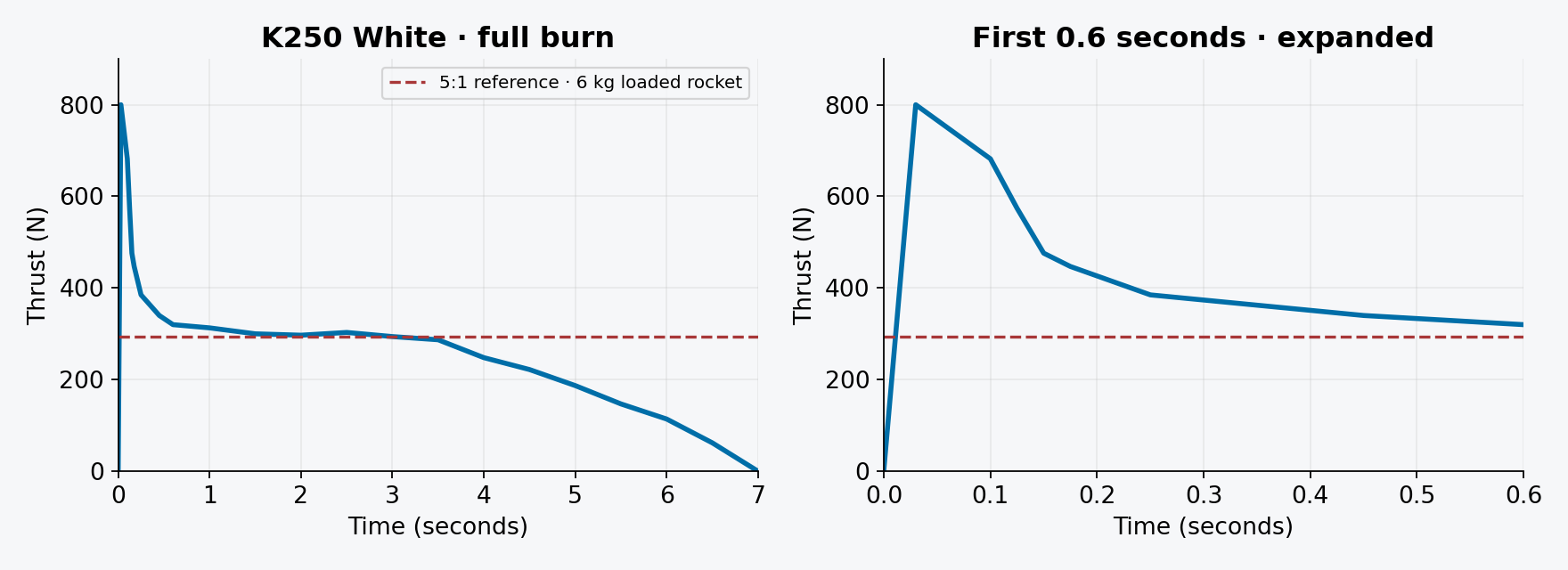
Same manufacturer data source as above. The dashed line is a calculated reference for an illustrative rocket, not a motor rating. The right panel expands startup.
For a 6 kg loaded rocket, weight is 58.8 N and the 5:1 reference is 294 N:
| Basis | Thrust | Thrust-to-weight |
|---|---|---|
| Nominal average from “K250” | 250 N | 4.2:1 |
| Mean over first 0.5 s, calculated from the supplied curve | 450 N | 7.6:1 |
| Early supplied peak at 0.03 s | 800 N | 13.6:1 |
| Supplied point at 0.6 s | 320 N | 5.4:1 |
The opening boost can provide acceleration that the nominal 4.2:1 average ratio hides. The first-half-second mean above is an explicitly defined calculation, not Tripoli’s prescribed definition of initial thrust. It is not a substitute for simulating the full curve.
The peak lasts only briefly. The rocket must gain sufficient speed over its actual usable guide travel before thrust falls. A long burn may be useful for a lighter, low-drag rocket, while the same motor could be a poor departure match for a heavier rocket. This example explains the tradeoff; it does not approve a K250 flight at 6 kg.
The comparison to make before flying
Load the exact motor curve into the same rocket simulation and compare guide-exit speed, acceleration, stability, and altitude. Include measured loaded mass, usable guide length, and expected wind. More thrust can improve departure but also increase structural loads and speed; more burn time does not guarantee more altitude.
These commercial K and L examples fall in Tripoli’s Level 2 impulse range. Check the exact reload’s current approval, required hardware, and flight requirements through Tripoli Motor Testing, and review the departure with the range safety officer.
Previous: Rocket Motor Classifications. Proposed next: Matching a Motor to a Rocket.