
Jaws on the Test Stand: 75mm Three-Grain L838
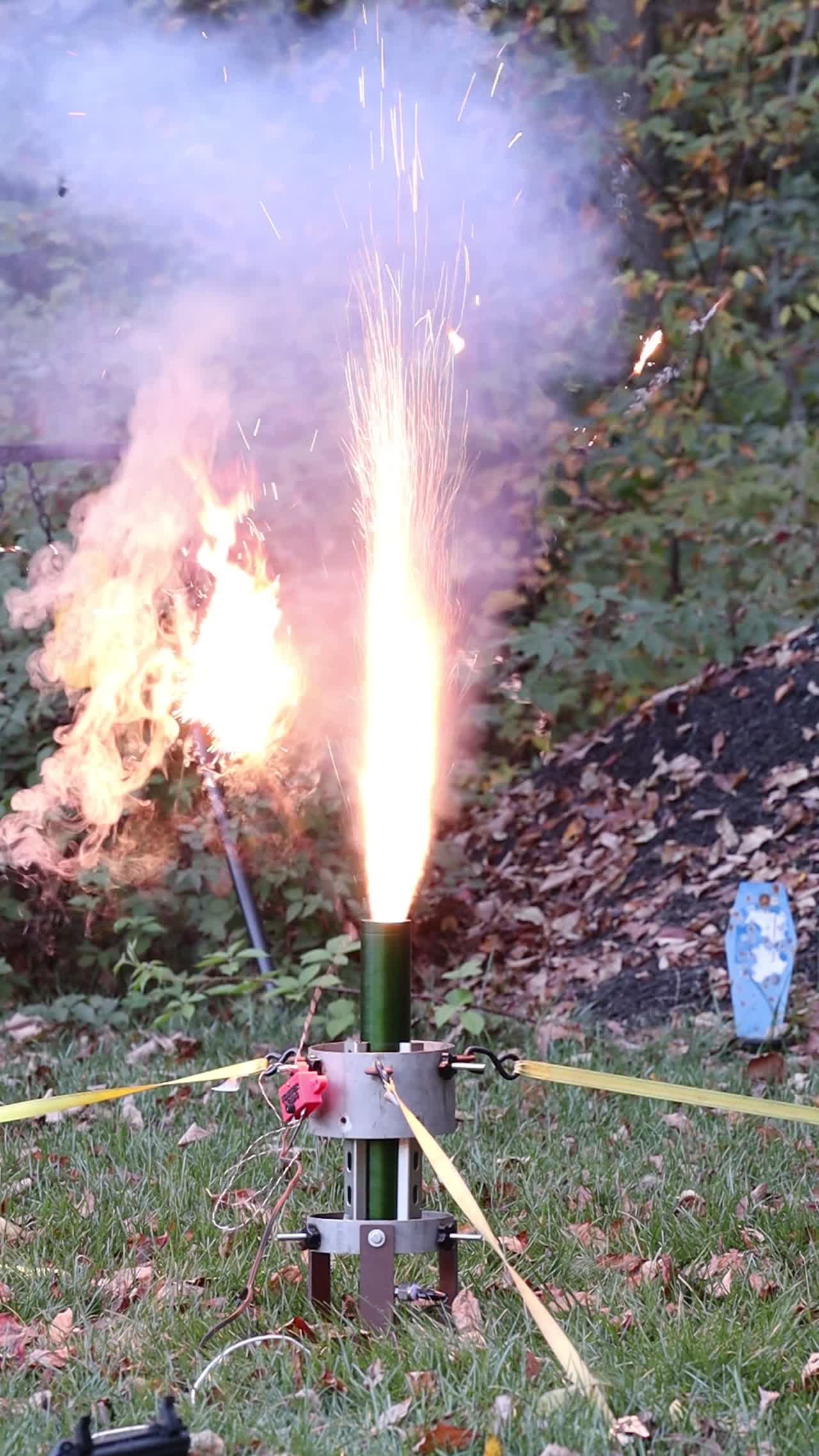
On October 22, 2026, we static-fired a 75mm motor with three grains of Jaws propellant. The saved test report labels the result L838, with 3,253.6 N·s of total impulse delivered over a reported 3.882-second burn. This is a ground-test record: the motor remains secured to a stand while instruments record its behavior.
The image above is a new still from the test footage. Watch the complete video below, then explore what the measurements mean.
The motor and the test
The 75mm description identifies the motor’s nominal diameter; three-grain means the propellant load is divided into three solid segments. Jaws is the formulation name recorded in Spark-RMDS, our motor development records system.
The firing file records a vertical test orientation and measurements from a load cell and a pressure transducer. The load cell measures force at the stand; the pressure sensor records pressure inside the motor. These are different measurements, and the saved report plots both against elapsed time.
| Measurement | Reported result |
|---|---|
| Test date | October 22, 2026 |
| Motor | 75mm, three grains, Jaws propellant |
| Test designation | L838 |
| Burn time | 3.882 s |
| Total impulse | 3,253.6 N·s |
| Average thrust | 188.4 lbf (approximately 838 N) |
| Peak thrust | 245.9 lbf (approximately 1,094 N) |
| Propellant mass | 4.01 lb (approximately 1.819 kg) |
| Reported specific impulse | 182.37 s |
Values above are transcribed from the saved test report, with rounded metric conversions. They describe this firing; the L838 label is a measured test designation, not a claim of commercial motor certification.
What does L838 mean?
The letter L describes the total-impulse class. The number 838 describes the approximate average thrust in newtons. Total impulse adds up thrust over the duration of a burn; it is the area beneath the thrust-versus-time curve. It is measured in newton-seconds, not units of energy.
The recorded 3,253.6 N·s falls in the L range, above 2,560 and up to 5,120 N·s. Dividing that impulse by the reported 3.882-second burn gives about 838 N, consistent with the report’s designation. See the NAR motor classification reference for the impulse classes.
Average thrust and peak thrust answer different questions. The average summarizes the whole burn; the peak captures its highest recorded force. Two motors can share an impulse class while delivering that impulse over very different lengths of time.
For more background, read our guides to motor classifications and reading a thrust curve.
Reading this firing
The saved plot shows a quick initial rise, a brief dip, and then a broader climb toward the highest thrust at roughly two seconds. Thrust subsequently declines before the final tail-off near the end of the recorded burn. Pressure follows a broadly similar rise and fall.
That shape is more informative than a single peak number: it shows how the delivered force changes throughout the firing. The video supplies a visual record, while the instruments supply the measurements. Flame brightness or apparent plume size alone cannot establish thrust.
The report also gives a specific impulse of 182.37 seconds. Specific impulse expresses delivered impulse relative to propellant weight and is commonly used to compare propulsion performance. Here it is the report’s result for this motor and firing, rather than a universal value for every motor using Jaws.
Jaws propellant: the formulation in context
Spark-RMDS describes Jaws as a high-energy, high-performance formulation. Its ingredient records span oxidizer, binder, curative, plasticizer, metal, and burn-rate-modifier categories. Those categories provide a useful way to explain the formulation without publishing its recipe.
- Oxidizer: supplies oxygen for combustion within the propellant.
- Binder and curative: form the solid material that holds the grain together.
- Plasticizer: influences the material’s physical properties.
- Metal: contributes to the formulation’s energy release and can affect its exhaust appearance.
- Burn-rate modifiers: influence combustion behavior.
This is a description of ingredient roles. Exact chemical identities, proportions, processing details, and preparation instructions are omitted. The formulation name alone does not determine a motor’s measured thrust or impulse; the results here belong to the complete motor tested on October 22.
About the records
This article draws on the October 22 firing file, its saved L838 report, the accompanying test footage, and the Jaws formulation description and ingredient categories in Spark-RMDS. The test date comes from the motor-test records; November 1 was the date the video was first added to this website.
The available records document one firing. They do not, by themselves, establish repeatability across multiple motors or explain every feature of the trace. The numbers are presented at the precision of the saved report, without implying a separate uncertainty assessment.